Wandering in Waikiki

Upon arriving in Waikiki, we collected our baggage and made our way outside of the terminal to locate the SpeediShuttles desk.

Before departing Auckland, I called the hotel to enquire as to whether they would be able to book our airport transfer to the resort for us. Unfortunately they couldn’t, but directed me to SpeediShuttle.

SpeediShuttleis a privately owned Hawaii based company. The company began operations in 1999 on Maui and has since grown to become the leading provider of ground transportation shuttle services in the state and the largest fleet of Mercedes Benz passenger shuttles in all of North America.
ethan
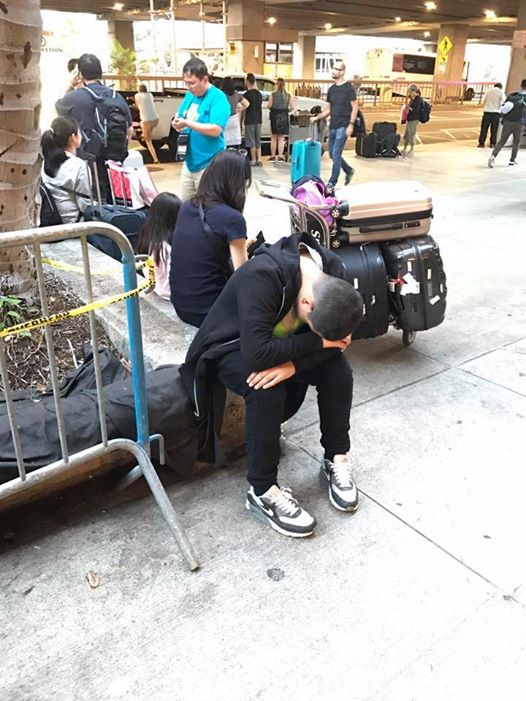
Ethan wishing he’d slept on the plane (Honolulu Airport)

The concierge was easy to find, and after checking in with her she mentioned that she was still waiting and attempting to locate another group of passengers before we could take off. After a 20 minute wait (with Ethan trying not to pass out from exhaustion), we were ushered across the street and into an air conditioned Mercedes – with wifi!

Our resort was the first stop after a 20 minute drive through morning traffic, we arrived at just after 7.30am to perform pre-registration.

Pre-registration is check-in before your room is available. Fortunately the resort Aqua Palms did offer pre-registration, meaning that we were able to check our bags and head out to breakfast. I did attempt an early check-in, however the guest right before me had asked for the same thing and managed to swipe the last available suite.

This meant that check-in for us would not be until 3pm however the concierge did suggest that we call back around midday to see whether any suites had become available. The entire process of pre-registration took about 20mins and after changing our clothes in the lobby restroom, brushing teeth and cleaning ourselves up as best we could, we decided to go foraging for breakfast.

Fortunately there was an IHOP restaurant directly next door to the resort.
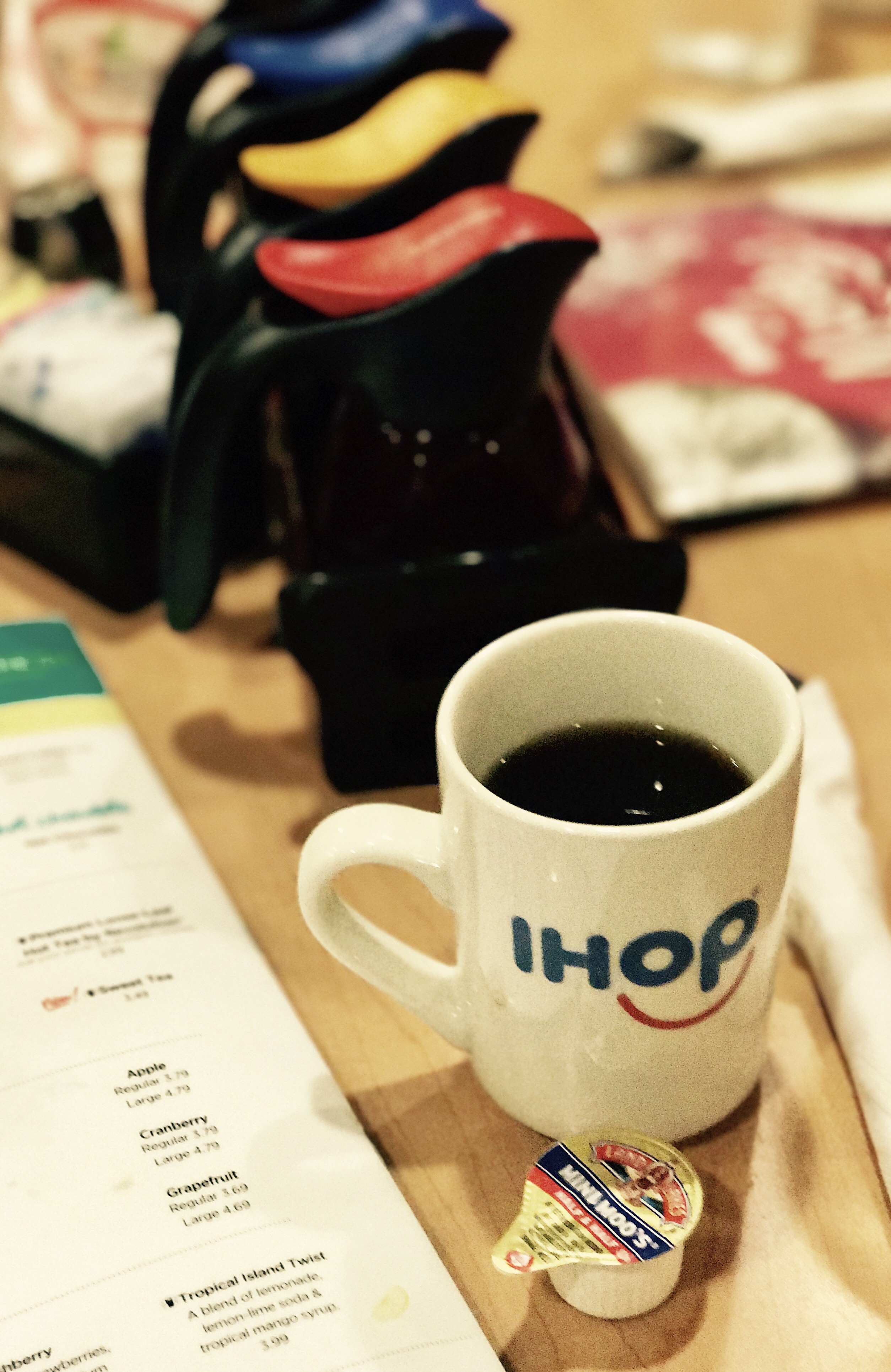
The International House of Pancakes is an American multinational casual family restaurant chain thats specialises in and serves breakfast. It is owned by DineEquity, with 99% of the restaurants run by independent franchisees in North America.

We were seated inside the restaurant, and given laminated menus to peruse.

Now these menus are huge. They include pancakes in different stack values, flavour combinations, breakfast ‘entrees’ (hot tip: they’re not entrees, they’re entire meals), omelettes, french toast, waffles and both sweet and savoury crepes.

I ordered a breakfast of eggs over easy (fried on both sides, but the yolk stays runny – “over” refers to flipping the egg, and “easy” refers to the doneness of the yolk), with a couple of slices of bacon and a 2-stack of traditional pancakes.

Christian ordered a full stack of pancakes and Ethan a stack of red velvet pancakes, which if I’m not mistaken were just regular pancakes with cocoa powder and red food dye added.

On the table were a raft of flavoured syrups – strawberry, blueberry, butter pecan, boysenberry and all pancakes were served with a dollop of whipped butter.

Now, personally? I didn’t think IHOP was anything to write home about, but the restaurant doesn’t really pretend to be anything that it isn’t; it’s a simple, yet clearly hugely effective dining experience where the food is exactly what you would come to expect at a chain that offers up breakfast items – and the food arrived lightening fast.
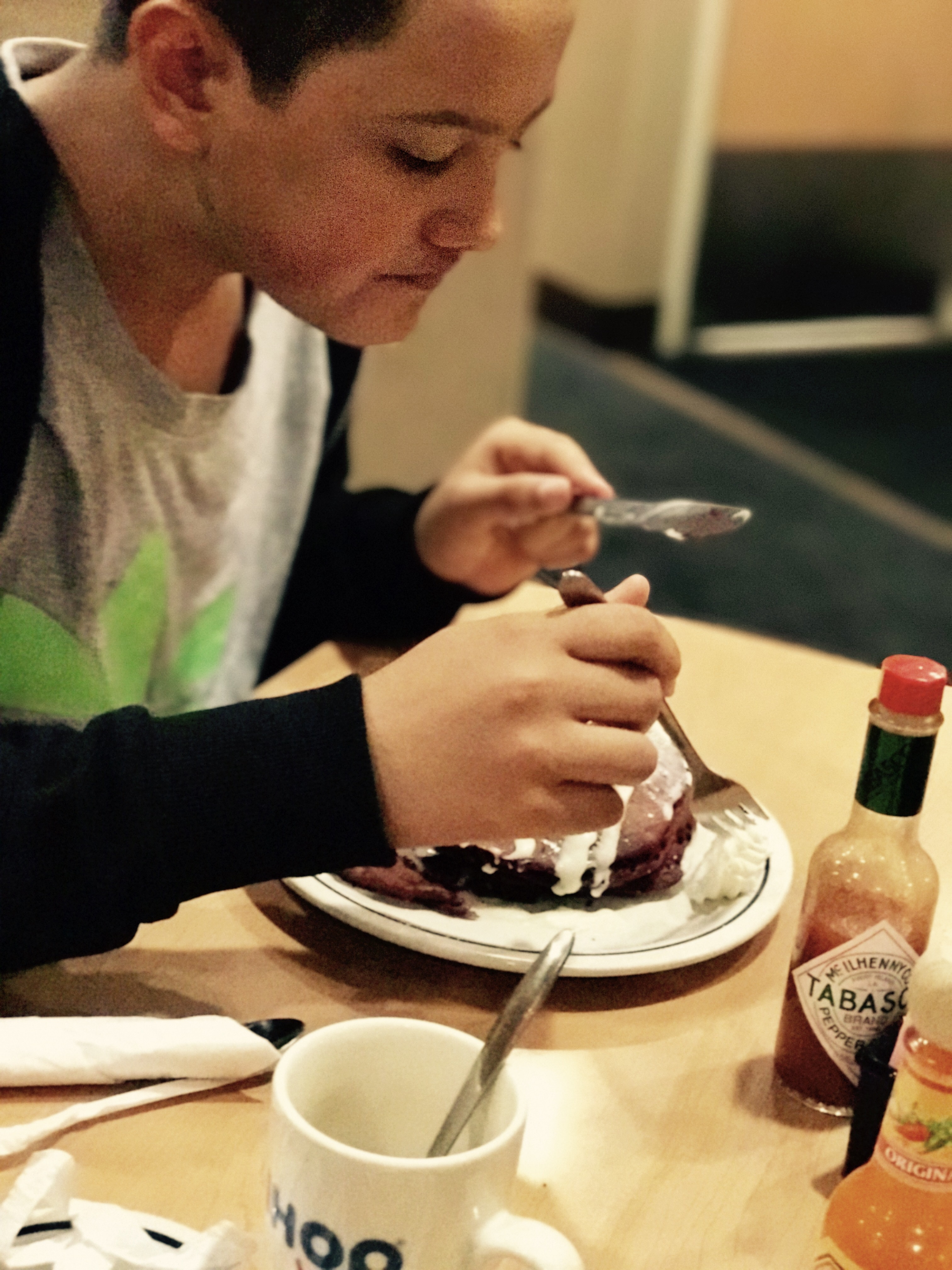
Ethan enjoying his red velvet pancakes.

Our server whose name was Heather, was a petite softly spoken girl whose face seemed to be permanently etched with a smile. She wore a frangipani in her hair (known locally  as Plumeria) and sauntered to our table, delicately balancing a huge tray of food above her slight wrist – it was impressive.

In terms of the bill, it was fairly inexpensive for a sit down restaurant, however when ordering or purchasing items in the United States, it pays to bear in mind that the price is not actually the price. In New Zealand, Goods & Services Tax or what we commonly refer to as GST, is included in listed prices in stores therefore advertised prices are what you will expect to pay when you come to checkout.

In the United States, federal, state and city tax percentages differ from state to state, therefore something that I purchased in Hawaii at CVS (a local pharmacy chain) that had a listed price of $3.99 cost $4.17 at checkout, however the same item in Los Angeles would cost $4.34 when taking into consideration state, county and city sales tax despite being listed in national sales advertising as $3.99.

Christian and I had decided that the first server who we got in the US was going to get a big tip. This was purely based on the fact that upon researching the average hourly rate for a server or waitress in the US, I discovered this equates more often than not to no more than $2-3 per hour.

We decided to give Heather a $40 USD tip (the equivalent of $58.76 NZD today) and watched her excitedly as she cashed out our table at the till. She blushed a furious pink, and she looked over to our table with a huge smile reaching broadly across her face.

After breakfast, we decided to jump on the hotels free shuttle, and make our way to the nearby Ala Moana Center.

ala

The Ala Moana Center is a mall on steroids, a premier international and local shopping destination with over 340 shops and restaurants. It boasts high end clothing, beauty and electronic stores, all in a beautiful open-air setting filled with lush tropical landscaping and koi ponds.

We wandered around aimlessly, desperately attempting to whittle away time to midday. We entered the department store Macy’s and I was impressed by the MAC, Urban Decay and Benefit makeup counters. I filed through a number of sales racks, however the tag prices weren’t the impressive deals that I had heard so much about online and from other visitors to the center.

We walked further into the center and I found the Sephora! Christian and Ethan sighed audibly and found a bench seat outside the store to wait. I promised I wouldn’t be long as I had in mind the items that I wanted to purchase.

The first stop in store was the Too Faced counter, where I picked up the ‘Better than Sex’ mascara for $23 USD – I’ve tried to find this mascara for sale locally in New Zealand and can confirm that online NZ beauty store LaFemme Beauty do offer it for sale – however it is often sold out.

Beside the Too Faced counter was the Kat Von D counter – I have been an avid user of KvD products for the last 3 years and love her Immortal Lash mascara, Everlasting Lipstick and Lock It foundation. I picked up the KvD Alchemist palette for $32 USD and her original Lolita everlasting lipstick for $20 USD. The local Sephora online store in New Zealand doesn’t currently offer the Alchemist palette and the lipstick runs at a cost of $30 NZD + shipping (orders over $55 NZD attract free shipping, but I have heard that the shipping time for orders from the NZ Sephora store is horrendous).

I also picked up the Milk Makeup Hero Salve, and a Tarte Tarlette Tease palette before returning to my weary travellers who were leaned up against one another drifting in and out of consciousness. I made a call to the hotel and was directed to the bookings to enquire as to whether there was a room available for check in.

I had booked a twin room, however there was only a room with a fold out couch available at the time I enquired about an early check in. I asked Christian if he would mind, and both the boys looked at me through desperately exhausted eyes that I accepted the room and we made our way back to the meeting point to catch the return trip of the complimentary bus.

The driver arrived and let the guest alight the bus, while she ducked out for a cigarette. I joined her, as there were signs everywhere noting that smoking wasn’t permitted anywhere on the site of the mall. She chuckled and said it was fine as long I wasn’t anywhere near an entry point to the mall and we lit up and shot the shit for ten minutes. I asked her about her job and where she lived on the island, making small talk. She explained to me that the company she worked for drove a number of passenger vehicles on the island and she didn’t really enjoy the route because it was repetitive but tips from tourists were a bonus; however it wasn’t really enough to stave off the boredom of a 13 hour shift.

I learned from this conversation that she was running late to schedule, meaning that the coach that was supposed to be 30 minutes behind her had almost caught up. She explained that this was due to the fact that rosters didn’t take into account meal or bathroom breaks.

Coming from New Zealand I was shocked by this, based on the stringent laws I know we have regarding driving regulations, particularly when driving heavy or passenger vehicles. This kind of work expectation I would imagine would lead to significant potential driver fatigue, putting both the driver of the vehicle and its’ passengers in danger. This is something that I have noted whilst here in the US; employment laws exist generally to protect and support the employer, as opposed to serving both employee and employer alike. It’s difficult to get vacation time – most people I told that I had planned to be in the US just shy of a month were surprised that I would be entitled to have my job back upon my return to my home country. And not just surprised; I’d go so far as to say they were amazed.

We returned to the resort after a short trip via coach and tipped the driver, before retrieving our luggage from the concierge and collecting our key cards. Christian eagerly turned the television on to CNN and we all fell asleep for several hours. After showering, we left the resort again via a double decker bus (costing a mere $2 USD per person for a single trip) and travelled back to the Ala Moana Center to have dinner at Bubba Gump Shrimp Company.

The Bubba Gump Shrimp Co. is a themed restaurant, based solely on the film Forrest Gump. The first of its kind was opened in Monterey, California in 1996 and since then they have expanded the business to 43 locations, 2 of which are located in Japan and 1 in Hong Kong.

The restaurant was heaving with guests, and we waited 15 minutes to be seated.

After being greeted by  Monica, a Midwest transplant who’d moved to Honolulu to study Earth Sciences. She was warm, bubbly and engaged us in conversation, recommending popular dishes and her own personal faves.

We perused the menus and Ethan noted there were some specialty bottomless frosty drinks with keepsake cups on offer. He eyed them excitedly and asked if he could order one as a souvenir.

I relented, and ordered one for myself as well. The cups had battery packs in the bottom, with buttons that activated flashing coloured lights in the base. As obnoxious as they were, we both happily enjoyed our icy treats.

Ethan settled on shrimp mac ‘n cheese (an American staple) to start and a burger with fries.
Flight Time.

After months and months of planning and an arduous overnight 8 hour flight from Auckland, my family and I landed at Honolulu airport in the early hours of Hawaii’s Saturday morning.

Unfortunately I didn’t take my own advice and refer to the SeatGuru app when choosing our seats on this plane.

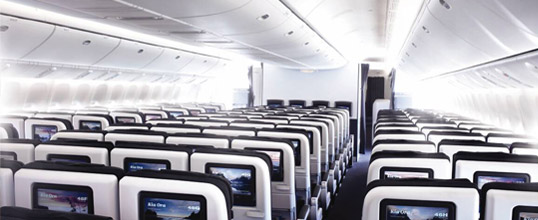
Because Ethan wanted to sit at the window, I was relegated to the aisle seat, which offered additional leg room but a screen on a retractable arm as there was no seat in front of mine. The first row in our cabin boasted only two seats, and I remarked to Christian about how envious I was about the woman in the row who was travelling solo and didn’t have an accompanying passenger in her neighbouring but vacant seat. Bah, humbug.

Upon finding our seats, we were confused as to why there was no screen available in the aisle seat, as we had paid for The Works Deluxe package electing to fly in the most comfortable cattle class option. I then observed an attendant assisting my aisle neighbour, whose seat also did not have a passenger in front, but a wall separating our cabin from the Business Class cabin ahead.

economy-538x220

He explained that the screen could be retracted and released from its partition by pushing down on a lever. As he explained this, I looked down to my left and observed a latch, pushing down hard to see if I could release the screen. I felt I had pushed with some force and without any luck, I gave up and assumed that the attendant, who had spoken to all others who were seated in the rows with retractable screens would surely come over before takeoff and go through the same procedure with me, as he had all of the others.

Alas – I was wrong. He started to walk down the aisle toward me and as he did so, I looked towards him and smiled. He looked down his nose at me and without missing a beat, sashayed further down the aisle to assist a colleague to ensure the rear doors were securely fastened. To say I was surprised would be a lie. Being a heavily tattooed person, quite often I am treated differently to your average Joe. People assume I do drugs, drink heavily, am generally a bad or unsavoury person…because I choose to adorn my body with art that I think is beautiful and have a penchant for body modification. First of all, if you think this? You’ve got screws loose. This is not 1950 and what I choose to do with my body is my business. I am sick to death of people remarking on my hair, clothes, body mods and appearance, like by simply existing I am asking for validation.

So, if you’re reading this? Just know, I’m not. I don’t need your validation. I’ve grown into a place where I really like myself and understand I have faults and flaws and am working on those, however I do not need you to comment on or remind me of aforementioned faults and flaws. Mind your own goddamn business.

And as for you (let’s call him Steve) Steve, air steward of Air New Zealand – you suck. Thanks for making me feel less than human by electing to ignore the basic requirements of your job, to make your guests comfortable and assist them where necessary. Cheers! Luckily for me however, one of his colleagues did ask if I had been shown how to use the retractable screen and when I said  hadn’t took great care to show me in detail how to use the screen and let me know that the screens would need to be placed away during takeoff.

With that out of the way, I’d like to explain why I didn’t enjoy flying with Air New Zealand in the slightest.

Firstly, as a heavier person with a big bum, I detest planes with narrow seats. Ironically, New Zealand’s budget airline JetStar offers more comfortable seating than the perceived ‘better value’ national airline. I prefer to fly JetStar intercity while in New Zealand, for the simple fact that the seats are wider and the belts stretch easily across my wide torso.

I sat down in my chair and groaned. Not only was the seat narrow, but the armrests did not lift, meaning my thighs spewed out underneath the hardened plastic arms. Before you roll your eyes and say to yourself, ‘she should just lose some weight so she can fit in the seat our buy two seats if necessary’ – I get it. But in this case, even if I had purchased the neighbouring seat, I wouldn’t have been able to lift the armrest, so that argument is moot.

I reclined my seat a wee bit, so as not to disturb the person sitting behind me who was busily typing away on a laptop placed on their tray table – I try to be considerate when flying because I get super irritated when the person in front of me comes flying backwards halfway into my seat and I have to struggle to use my personal screen. I was able to stretch my legs out and sit very low in the seat, which somewhat replicated lying down…but not really.

So, in short? The flight sucked. I have a return flight on Air New Zealand to look forward to on the way home from Honolulu to Auckland so I’m grateful for the fact that it’s only eight hours. Should I ever return to Oahu, I will do so on a Hawaiian Airlines flight!

Charli x

Emperor Lounge

I like to think of myself as a well seasoned traveller, as in my role as an event manager I fly between cities frequently. The majority of my family also live in Australia, while I live in Auckland, New Zealand meaning I am back and forth across the ditch often.

And I hate the airport. Don’t get me wrong, travelling on a biometric passport has made all the difference in streamlining the customs process, but the whole palava of getting your bags checked in, filling out declaration forms, validating your identity with customs officers…it’s a whole mess that stresses me out to no end.

While doing a tonne of research for both our trip and subsequently this blog, I found the LoungeBuddy app, which allows users to view, book and access some of the most luxurious lounges airports around the world have to offer. While Auckland International Airport aren’t registered on LoungeBuddy, they do offer travellers the option to purchase access to their Emperor Lounge.

After completing our bag drop, hugging and kissing mum goodbye several times and completing security clearance through customs, we made our way through the Mecca of duty free stores directly to the Lounge, where we intended to unwind and relax before our 8 hour flight to Honolulu.


The Emperor Lounge is located on the first floor after security, to the right of the Benefit & MAC counters. It boasts a sleek entrance and is relatively easy to find as the lounges are all signposted.


Upon arrival, we confirmed our reservation with the concierge and were asked to present our boarding passes as forms of identification. I looked up my booking reference using the wonderful TripIt app and once registered within the booking system, we were directed through to the lounge.

The lounge was relatively busy at the time of evening we arrived (5:30pm) so we seated ourselves in the dining area where there was a free table.

You are provided with the wifi login details upon arrival and encouraged to help yourself to meals and beverages.

The selection of hot items is small, and a little lacklustre. The soup option was a creamy kumara concoction that looked pale and underwhelming, so I elected to move directly to Malaysian chicken curry on offer, accompanied with either mashed potatoes or jasmine rice. There was also a tomato based vegetarian curry, laden with carrot and tofu. Christian tried this fare and declared it to taste similar to “watered down ketchup”. I told him I’d pass.

Despite the options being far from numerous, I can tell you that the chicken curry was to die for. I had two helpings!


There is also a relatively well stocked bar, offering sparkling and still wines (both red and white), hard liquor and a selection of New Zealand beers, mixers and fruit juices. I poured a double Chivas Regal 12 year old over ice for Christian, and helped myself to a very strong gin and tonic, in the hope it would put me to sleep on the plane.

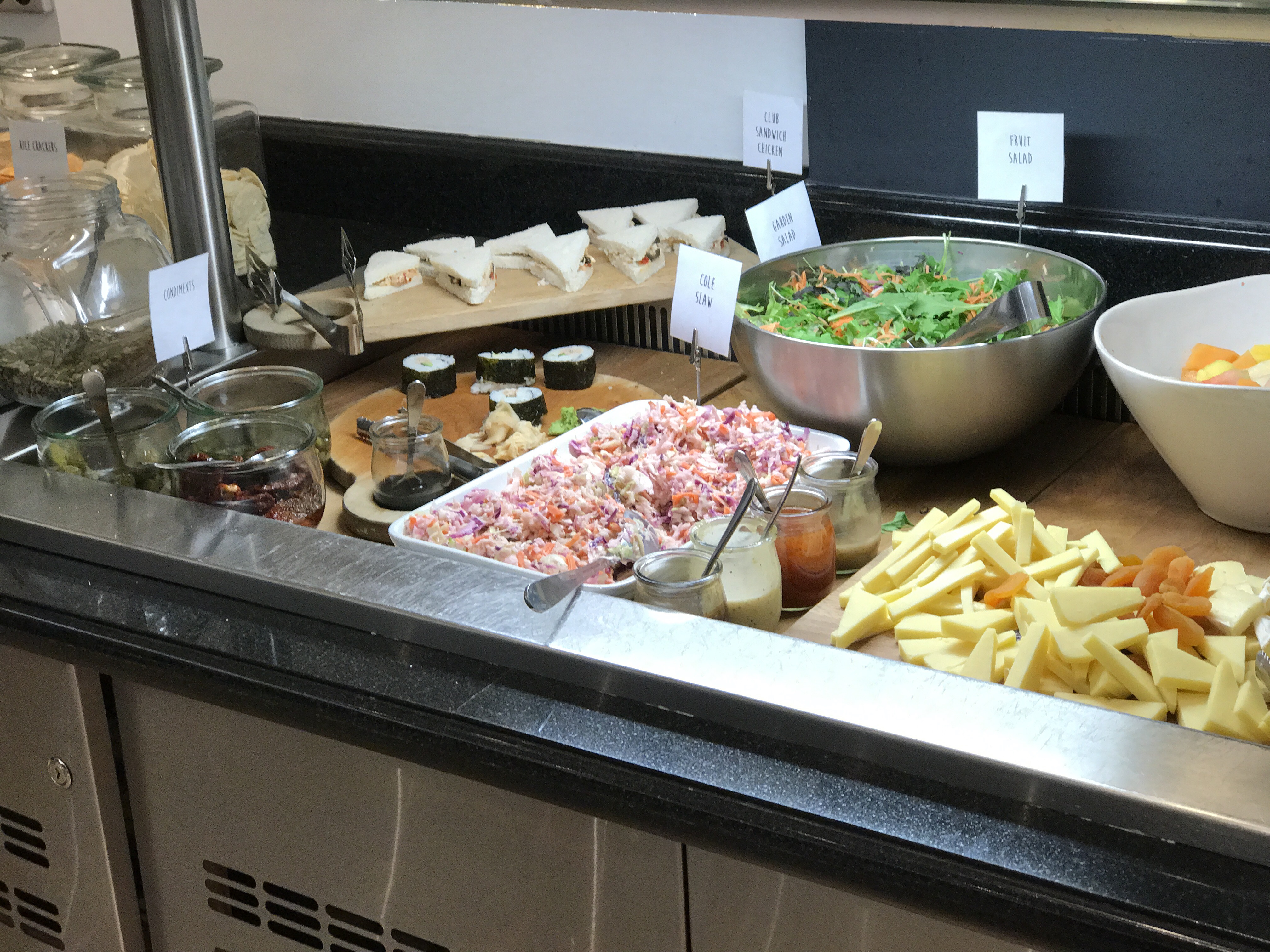
The buffet also includes a salad bar, complete with dressings, cheeses, club sandwiches, seasonal fruit and sushi.


These petit fours were delicious, and we found ourselves returning for more several times.


I did note that while the buffet was small, the staff were vigilantly replacing items quickly and efficiently, to ensure that the fridges were never without bottled water, non-alcoholic beverages, mixers and beer & wine as well as replenishing the hot buffet items and pastries often.


After chowing down on the chicken curry and pouring myself a second G&T, I setup my laptop to respond to some emails, and check up on Facebook. The last time I was at the airport for an extended period of time, I ended up paying $20 NZD in internet access fees, as Auckland Airport has some of the worst wifi pricing in the land. At Christchurch and Wellington airports, service is free and unrestricted in the terminal whilst in Auckland your first ~500MB is free if you register your email (read: sign up to be spammed for eternity).

The several drinks we consumed over the 2.5hrs we were in the lounge would have easily been priced at one of the flight side bars at well over $60 NZD.

Once we’d eaten more than our fill, I noticed that the lounge had freed up a bit and some armchairs had become free. We settled ourselves in and dug into some petit fours, plugging our phones in to charge in the conveniently located outlets in the wall beside the armchairs. There are quite a number of outlets in the lounge for recharging devices, as well as several desktop PCs setup to provide internet access to travellers without laptops or those who choose the convenience of using a desktop that has been setup and connected to high speed internet.

Christian had a cup of green tea (yes, self tea and coffee service is available for your convenience) to accompany his dessert. We chatted and watched the departure screen above our heads, denoting when travellers should think about being on the move toward their gate. At just before 8:30pm, we strolled leisurely toward Gate 10 for boarding. I stopped in for a cigarette in the terminals’ smoking lounge before making my way down the ramp to the gate as we had plenty of time to board. I usually wait towards the end of queues to board anyway after the attendant makes his or her announcements, as I see no sense in rushing to be on the plane first. Ultimately, the pilot isn’t going to take off until the plane doors are securely fastened and all registered passengers are on the flight, so running to get to my seat never made much sense to me.

Before we departed the lounge, I packed a few of the water bottles on offer in the lounge into my carry on luggage for each of us, so that we wouldn’t have to purchase it after we left to board. Plane cabins always leave me super dehydrated no matter the length of flight, so I did appreciate having easy access to water without having to turn on my call light for the attendant while the plane was in flight and all the passengers around me were dozing in the dark.

So, in all – would I recommend the Emperor Lounge in terms of cost versus benefit? Absolutely. If you run out of time to shower, no problem! Take one there.

Want to get blotto without having to fork out $13 for a tap beer? Done!

Want to avoid eating airport fast food? Done!

Need internet access to pay that utility bill you forgot about? Too easy!

Pricing starts at $49 NZD per adult for 3 hours access. Children under the age of 12 are priced at $24.50 for the same duration, however you can elect to purchase a longer stay (8 hours access) at a slightly higher cost.

Charli x

Just a tip!

Tipping a really confusing custom as someone who comes from a country where tipping isn’t required. I figure this is because in New Zealand, our minimum wage equates to, or at the very least is supposed to be something of a ‘living wage’.

Whilst tipping is largely viewed worldwide as an American practice, the history of tipping can be traced back to a practice adapted from Europeans, whose own history of tipping goes back to at least Tudor England, when overnight guests would leave a small gratuity (or vails) for the house servants.

I did some research into the average hourly wage of someone in the service industry in the US, and was horrified to learn that some wait staff can earn as little as $2.50 per hour. In order to make anywhere near enough money to survive, pay rent, utilities, transport costs and just general expenses associated to existing, a waitress/waiter would need to bus at least 4 tables an hour, expecting to receive at the very least $5 USD per table, giving them an hourly rate of $22.50.

If you truly think about the patronage in a restaurant, dinner service during the week is likely to be between the hours of 7pm-9pm. If a waiter begins work at 5pm, it’s likely that during the quieter hours in the lead up to dinner service, they’ll be lucky to earn $2 in tips.

Google will tell you that the median tip rate in the US is $13/hr, which bumps the average full time wait staffer to $42,120 a year based on a 40 hour week. Still, I consider that a lean income. If you perform a quick analysis based on this income, you’d have $23,065 net to work with. And in reality, when you add dependents, insurance, medical expenses into the mix – it’d be tough to make ends meet.

It also makes me super uncomfortable that the culture of tipping places so much power in the hands of the customer. Again, as I’ve said before in this blog, I don’t believe that people are inherently bad; but if you go searching on the internet for stories of badly behaved patrons, waitresses being sexually harassed or inappropriately propositioned – you’ll find them. I feel in these scenarios, there isn’t a lot that a server can do to defend themselves if they want to be tipped at the end of the ordeal.

So, I want to make sure I tip handsomely where I can. In New Zealand, if I receive exceptional service, I will tip a lot. I once overheard my waitress in our local cafe talking to her colleague about how she was stressed out about how she was going to pay her rent after forking out a huge sum of money for textbooks during her last year of university, so palmed a lazy $50 note into her hand when she came to collect my discarded dishes at the end of the meal. Could I have used that money? Sure. Did it hugely inconvenience me to ‘lose’ the money? No.

Did it make a difference to that young lady? Well, I hope so. I think it’s so important to be kind to others who’re less fortunate, so the idea of tipping incorrectly and as a result causing upset or offence causes me hypertension.

I’m huge on the idea of communities behaving like tribes. If we all work together to support each other, we can all achieve and be successful. I’ve been trying to teach my 11 year old son about being kind and taking care of our wider community, those people that fall outside of our immediate family and friends.


Recently I became acquainted with a wonderful Auckland based filmmaker named Rachel, who runs a Facebook group called ‘Mums Mince’.

Three years ago, Rachel cooked a big pot of her mother’s famous savoury mince and dropped it off at the Auckland City Mission to help feed the homeless.

She made huge efforts to do this once a month, but as a solo working parent found it difficult to keep up with the demand. After putting a call out for support on Facebook to her friends, she began Mums Mince which has grown into a 1,500 strong group of strong, community driven women who inspire each other to help feed those in our city who are a little down on their luck, a little less fortunate and just in need of a hearty meal.

Because we are away from home for an entire month, I contacted Rachel and volunteered to do 2 consecutive Saturdays in February.

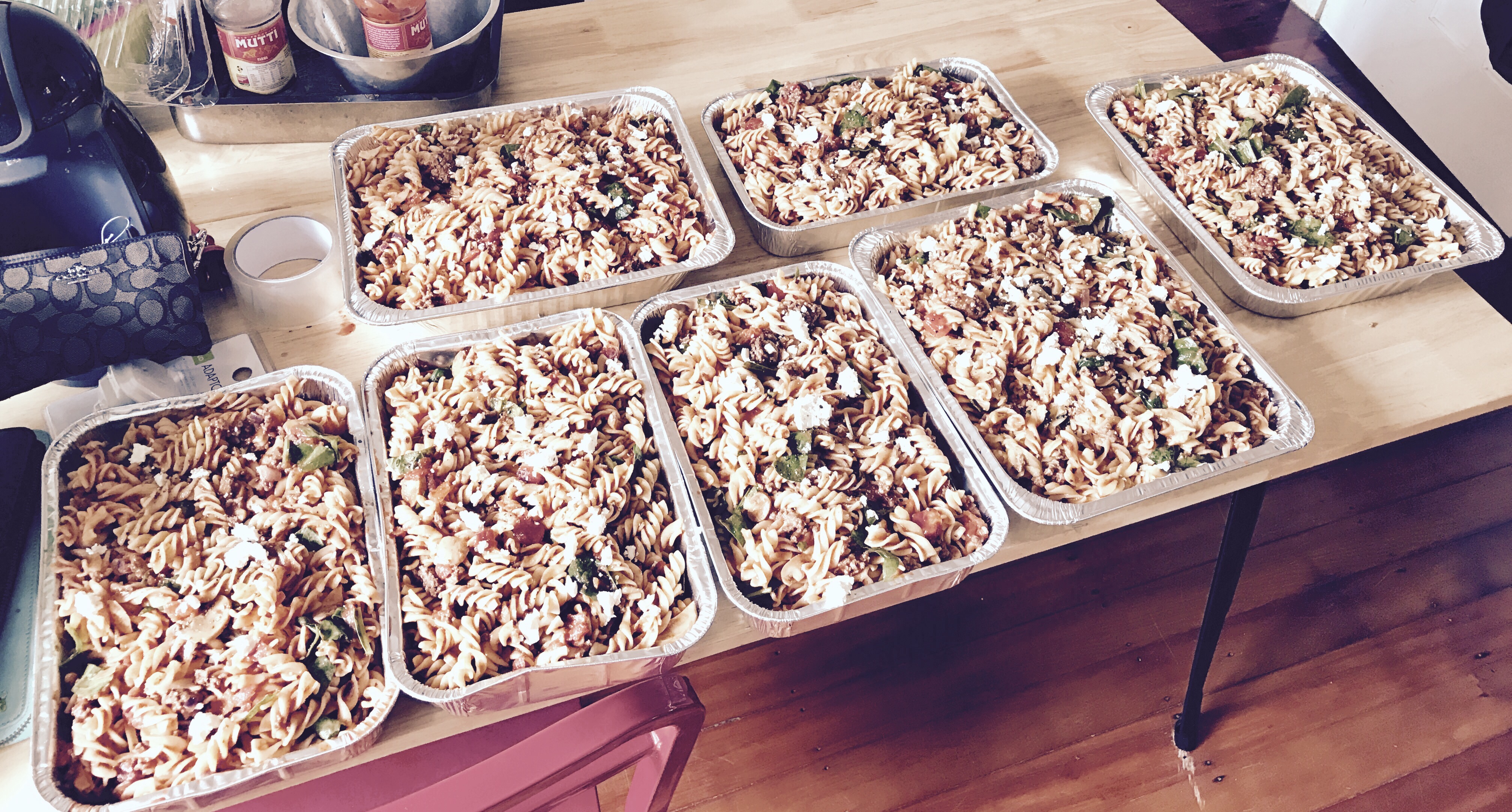
Beef, Mushroom & Spinach Pasta.

My son Ethan and I pored over boiling pots of salted water for several hours last Saturday afternoon, cooking 5kg of pasta in our tiny, not made for cooking in large quantities kitchen. My weekends have been jammed with work, events and birthday celebrations to the point where I feel like for the last 3 weeks adrenaline and coffee has kept me speeding through it all. After picking a tonne of spinach out of my wee vege patch, we mixed up 5 large trays of pasta, packed them into a laundry basket and delivered them to the Missions’ drop in centre in plenty of time for the evening meal at 5pm.

I watched Ethan tentatively as he manoeuvred through the queues that had started to form at the Mission, scores of people waiting for their opportunity to sit and break bread with friends and other strangers for the evening.

I could see a barrage of emotions swim across his face as he walked through the Missions’ doors, and as much as I had tried to prepare Ethan for some of the things he would see, it became clear that the reality of homelessness in our community began to hit him like a tonne of bricks.

We didn’t make much of a fuss, walking into the kitchen area and placing our donations on the benches for volunteers to retrieve; as we left, there was a cacophony of very grateful ‘thank yous’ echoing through the dining hall, out into the street where we’d parked in a loading zone.

My son asked a lot of questions on the way home, about why certain things in the centre appeared the way they did, why people there looked a certain dishelved way; I met his curiosity with measured answers, imploring him to tell me why he thought these types of small acts of kindness were important in a city and even moreso a society, where the idea of community has become less and less important.

I intend to carry on this work with Rachel and beyond when I get back from the US and have even been lucky enough to connect with some wonderful people who are excited by the idea of mucking in to help.

On that note? Here’s some advice on when it’s appropriate and expected to add gratituity to your bill in the US and some indicators on what would be an appropriate and unmiserly tip!

Hawaii

Tipping is even more crucial in Hawaii, where the cost of living is higher than the average US state. Because of this, Hawaii has joined a growing number of areas that will add an immediate 18% tip and include this in your bill, however I’ve included some suggestions below on what to tip:

  • Maid service/Housekeeping – A friend told me recently while vacationing in NY that she would leave a $3 USD tip per day for her maid, which resulted in housekeepers fighting over who was going to turn over her room! As a general rule, $1-2 USD (leave on dresser) is appropriate, however the better you tip, the better service you can expect to get!
  • Bellboy – $1-2 USD per bag
  • Taxi – $1-2 USD or 15% of overall fare
  • Wait Staff – 15-20% of overall pre-tax meal costs
  • Bar Staff – 10-15% of overall cost of drink/order pre-tax or $1 per drink
  • Tour Guide – As you depart from the tour, reward a good tour guide by tipping 10-20 percent of the cost of the tours’ ticket.
  • Doorman – when he hails you a taxi, tip him $1-2 USD
  • Hotel Concierge – It’s the concierge’s job to assist guests, so technically its not a requirement that you tip , but if you get great service, tipping anywhere between $5-20 is reasonable.

Los Angeles

California’s labour statute spells out exactly who cannot receive any tips: Neither the restaurant’s owners nor its agents are permitted to take tips. Agents of the owner include managers and supervisors; essentially, those who supervise other employees, or have the authority to hire or fire employees. Even if they wait on a table, or help deliver dishes, owners and their agents cannot receive any tips.

For wait staff, barbers, attendants and tour guides in California, your tip can be calculated as follows, based on a percentage of your total bill of service:

  • 10% – not totally happy with the service given
  • 15% – service was acceptable, not exceptional
  • 20% – outstanding service.

In most communities, 15-20% gratuity of the overall bill(s) is an acceptable standard. This is highly subjective however and will vary from state to state.

Nebraska

When you receive tips as part of your compensation, an employees legal rights under wage and hour laws become a bit more complicated. The rules about what counts as a tip, how much the employer must pay you, and whether you have to contribute to a tip pool (among other things) all depend on the laws of the state.

The basic rule of tips, under federal law and state law, is that they belong to the employee, not the employer. Employers may not require employees to hand over their tips unless one of these exceptions applies:

Nebraskan State law allows the employer to take a tip credit. Nebraska’s minimum wage is currently $8 an hour (for 2015). Because the state minimum wage is higher than the federal minimum wage of $7.25, employers must pay employees $8 an hour; this means employers may pay tipped employees an hourly wage as low as $2.13 and may take a tip credit of up to $5.87, as long as the employee makes enough in tips to bring his or her wages up to $8 an hour. If not, the employer must make up the difference.

What I’ve learned so far about gratuity is that it could potentially mean the difference between a person being able to eat, get to work or even pay their rent check. And with the words of Rihanna’s grandmother ringing in my ears, I bid you good luck and ask you to be kind when tipping!

Charli x

VWP.

Having never travelled to the US before, I didn’t have the foggiest idea of what I would need to enter the country, or how to get a Visa. I assumed my husband would know, as he has extensively travelled through North America before…this was a bad assumption, as on his previous trip he utilised a travel agent to do everything for him.

Whilst I think travel agents are great, I like to think I’m a fairly competent person who likes to save money where I can. As I’m sure you can imagine, the  thought of paying a ‘professional’ to perform tasks that I can do myself with a few clicks of a mouse gives me sweaty palms.

So, off to the internet I went. After perusing the US Embassy’s website and the Department of Homeland Security’s difficult to navigate government page, I gave up and resorted to scrolling through my Facebook feed, like a good defeatist.

As luck would have it, an acquaintance had posted in a group I am a member of, stating that she would be travelling to Hawaii in the upcoming month and wondered if she’d need a visa.

As the group is full of well travelled women, there were a tonne of really useful, well informed comments on how to go about getting an ESTA, which is a condition of entry to the United States for New Zealand citizens.


The Electronic System for Travel Authorization (ESTA) is an automated system that assists in determining eligibility of an individual to travel to the United States under the Visa Waiver Program. Any individual wishing to travel to the United States visa free must first apply for permission on-line using ESTA.

The Visa Waiver Program (VWP) is a program of the United States Government which allows citizens of specific countries to travel to the United States for tourism, business, or while in transit for up to 90 days without having to obtain a visa.

So, I whipped out our passports and my credit card, submitted our applications and waited anxiously to see whether our applications were approved. With the current political climate in the US being pretty tumultuous with the succession of President Trump having caused huge discourse and rifts in American society at large, I can say the wait was nervewracking. In hindsight, I think I would have performed this exercise before shelling out almost $3,000 NZD in airfares, as I took a significant risk in assuming that our applications to enter the country would just happen. Shame on me.

Just so we’re clear – ESTA is not a visa. It does not meet the legal requirements to serve in lieu of a US visa when a visa is required. Travelers that possess a valid US visa may travel to the United States on that visa for the purpose it was issued.

In this case however, fortune did indeed favour the brave, and once payment was rendered, our applications were approved within a 24hr period. Stoked, we can legally enter the country!

It’s advised that you at least allow yourself 72 hours (3 days) when applying for an ESTA. However, if you are planning to visit the U.S. it is recommend to apply as early as possible. If your Travel Authorization is denied you will have to apply for a visitor visa at a US embassy or consulate. Sometimes, appointment slots are difficult to attain, and may take weeks. You can however resubmit your application if it is declined and circumstances have changed after a 10 day period that may mean your application will be approved.

If you’ve ever been denied a visa to the US, you won’t be able to travel on the Visa Waiver program and will need to go through the process of applying for a visa via your local US embassy.

The one other compulsory requirement is that you have an electronic or biometric  passport. This is due to the fact that the electronic passport contains biometric information that allows the TSA/US Customs to authenticate the identity of travellers.

The application process takes up to 20 minutes in total and is super easy – a series of basic identifying questions and dropdown menus, and should be approved or declined within a 72hr period. If you’re travelling in a group, you can also submit your application together ensuring approval at the same time.

Good luck, happy travels!

Charli x

Guest Appearances.

Hotels are expensive and often as a guest, you’re left feeling disappointed by a proprietors lack of being able to justify the exorbitant rates that are being charged. Or, at least this has been my experience.

Whilst there are awesome metasearch sites available to reduce your expenses like Booking.com offering up to the minute alerts on price drops and discounted rates,  when booking accomodation on sites and apps like HotWire you’re often like rolling the dice on whether or not the place will be a complete dive or an elegant experience.

My family and friends welcomed in the 2017 New Year together in a holiday home in Parua Bay, located in New Zealand’s gorgeous Northland.

My brother in law rented the home using the Airbnb app.


Affectionately named Rammed Earth by the owners, the house had recently been vacated by its previous tenants, and the owner decided to try his luck renting out the property as a holiday home.

It had recently been furnished with some pretty funky KMart appliances, but save for a fairly well stocked kitchen and beds and pillows without linens, there wasn’t much else going on.

Because we’d travelled to Northland for the specific purpose of sun, surf, sand, beers and laughter, the lack of a television or wifi wasn’t too much of a cause for concern for the majority of our group (shout out to my BFF Dave who was losing his damn mind because his mobile carrier has pretty lacklustre service in lower density areas).

Based on our NYE experience and after doing some research (read ‘googling’) on the most effective way to travel abroad, I figured that I would sign up for my own Airbnb account and do some sleuthing and cost/benefit analysis on whether staying in Motel 6’s or Holiday Inns was going to more financially viable…being on the road in a foreign country where your own local currency buys theirs at $0.70 to the dollar is an expensive exercise anyway!

Airbnb is an online marketplace and hospitality service, enabling people to list or rent short-term lodging including vacation rentals, apartment rentals, homestays, hostel beds, or hotel rooms.

Airbnb is a community built on a lot of trust; essentially as a guest you’re trusting that your host isn’t going to falsify their ads like some hoteliers are wont to do, leading you to rent a roach infested hovel. As a host, you’re entrusting a complete stranger with unadulterated access to your home with the hope that they don’t screw you by throwing a kegger and trashing the place.

When you apply to rent an Airbnb home, you are invited to tell the host a little about yourself, your accompanying guests if any and the reason you are travelling and wanting to rent their space. I figured because my husband Christian and I are working professionals travelling with our son, it would play in our favour. And in some ways, I think it did.

Airbnb Waikiki, Wyndham Resort

Our first attempt to book a home was in Waikiki. There are plenty of serviced apartments for you to choose from, however the majority of these places don’t have functional kitchens or are similarly priced or more expensive to the many of the resorts near Ala Moana Boulevard. I guess this is because the hosts roll their daily resort fee into the overall daily price of the rental.

A resort fee, also called a facility fee, a destination fee, an amenity fee, or a resort charge, is a separate mandatory fee that a guest must pay to receive the key to their room rental. The fee is charged in addition to the room rate. As far as I was able to tell, most of the resorts in Waikiki charge this amenity fee. In other US states, some Airbnbs have an occupancy tax that you will need to pay on top of your daily rental fee, however in some instances hosts offer 5-20% discounts on long term stays which sort of counters this charge.

There were very few Airbnb options in the area we wanted to stay while in Hawaii, so I ended up booking a twin room at the Aqua Palms Resort for the paltry sum of $139 USD per night. On top of this, we will be charged around about an additional $18USD per day, based on an average of 9.25%-13.25% of our overall room charges.

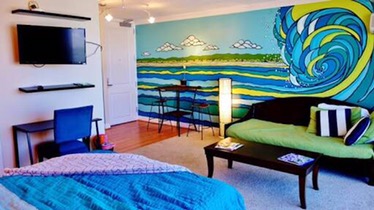
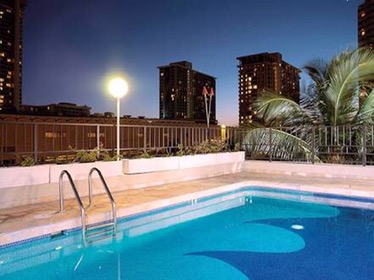
Aqua Palms Waikiki, Outdoor Pool.

The Aqua Palms‘ hotel resort fee includes:

  • Beach access
  • Beach loungers
  • Beach towels
  • Fitness center access
  • Shuttle service
  • Internet access
  • Newspaper
  • Phone calls
  • In-room safe
  • In-room coffee
  • Laundry service
  • Outdoor pool
  • Microwave

Regardless of what I kind of think is an egregious for a hotel to charge, as service is what you’re paying in most cases over $100 USD for, I still feel like we got a great deal on our room.

Both Los Angeles & New York also charge additional fees for tourists under the guise of ‘accomodation tax’. Whilst I think this is a great way for the cities to collect additional monies from visitors and capitalise on their statuses as ‘Must See Places Before You Die’, I do kind of think it could be also be a deterrent for some working to a budget and…well, it’s a bit mean.

Guests who occupy a hotel, motel, bed-and-breakfast, boarding house, or transient club, apartment or room pay the Hotel Room Occupancy Tax to the hotel operators or remarketers (when a room has been purchased from an intermediary like Airbnb). The hotel operators turn this money over to the City. The tax  varies, and is based on the cost of the room.

A private house in which a room is rented is not considered a hotel, therefore may not be liable to pay these taxes to the city. Unfortunately I cannot confirm this, as we elected to only stay in homes where we would be the sole occupants.

Our first stop after Hawaii will be in LA and as my absolute favourite band in the whole world Concrete Blonde gained infamy and was formed in West Hollywood, I really wanted to stay here. Celebrity hair stylist Guy Tang also has a studio in West Hollywood, and I have on good authority that it’s Drag Queen City, so I feel like it will be a home away from home of sorts for me.

Airbnb, West Hollywood, CA

Our Hollywood Airbnb is pretty basic, a 2 bedroom apartment located 2 blocks from the WeHo Gateway Mall, 15mins from the Walk of Fame, Chinese & Dolby Theatres and most importantly to this self professed Fat Kid, around the corner from the world famous In-N-Out Burger.

I had decided up front that there were several amenities that our Airbnb selections would need to have; firstly and of the utmost importance, we all needed somewhere to sleep. You would think that by specifying that you have 3 guests, at least 2 beds would be necessary, but some hosts will advertise their homes stating ‘sleeps 4′, when the reality is that they have a fold out couch, an arm chair, a bean bag and a blow up bed. If anything, this is a con to Airbnb and definitely something to watch out for.

Secondly, it was pretty important that we have access to a washer and dryer, or at they very least a laundry service of some kind. The appartment building we are staying in in WeHo has coin operated machines in the basement which we can access, which means I can ensure I’m not dragging around a suitcase of rank clothes, stinking to high heaven with my sons’ prepubescent stench! Check.

Thirdly, the location of the apartment needed to be easily accessible from LAX and be close to public transport, a general market and city sights. This Airbnb fit all criteria.

Lastly, we wanted to make sure we were able to communicate, FaceTime, call or Skype our families while we were away. High speed Wifi access was a definite requirement, so that all of our devices could comfortably be connected. Check.

The end cost was fairly reasonable for a five day stint in Hollywood, and when compared to the cost of staying in any half way decent Hollywood hotel, was pretty cheap:


Airbnb does charge a service fee (as listed above) per reservation, but even when taking this fee into account, booking via the Airbnb app is still at least 35% cheaper than the hotels that I compared against. For example, in New York to stay in a half way decent boutique hotel with a shared bathroom, I was looking at budgeting $2,500-$3,000 NZD for an 8 day stay in Lower Manhattan.

We were lucky enough to find a Yoga Studio in Williamsburg on Airbnb, with a pretty cheap price tag of $1,524 NZD. When compared with the prices being charged by some of the hotels on Booking.com that looked as if they hadn’t been refurbished since Nancy Spungen was murdered (insert NY reference), this is a really great deal.


The amenities included in the studio are the same as those listed in the WeHo apartment, but this studio also has a huge roof deck overlooking Williamsburg in Brooklyn, a mini mall downstairs that includes a coffee shop, art gallery, clothing store as well as being right across the street from two of the biggest vintage clothing stores in Brooklyn.

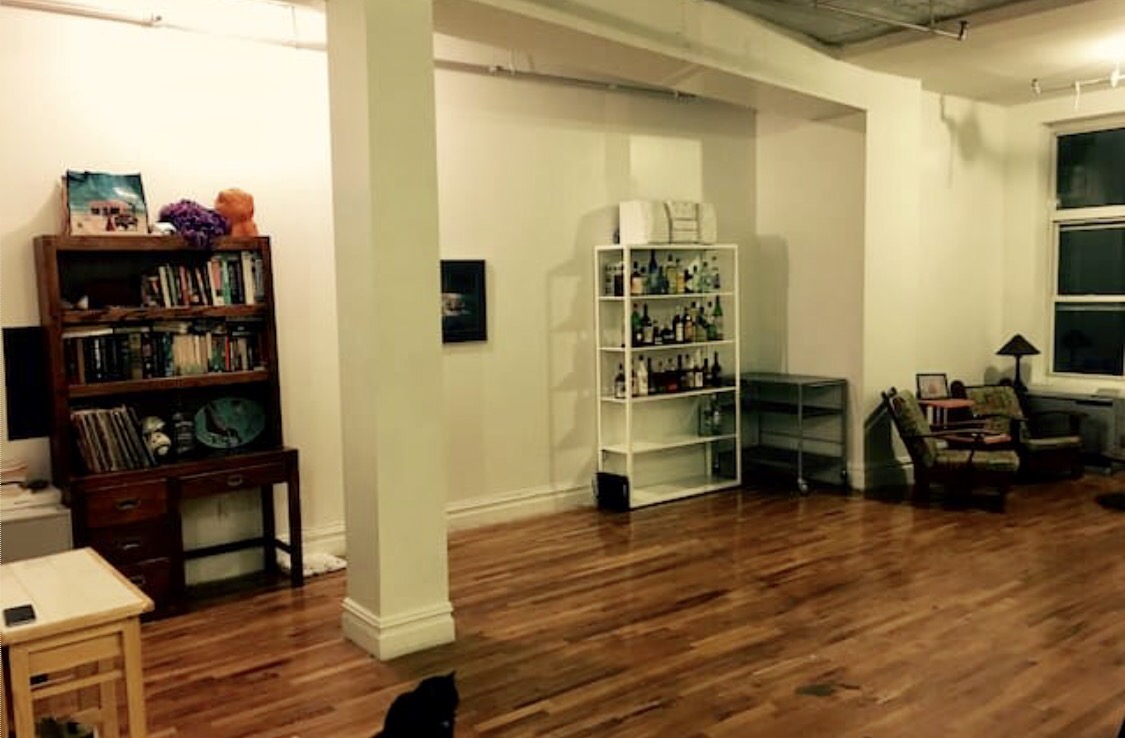
Cat tax.

The studio is located quite centrally, 2 blocks from the L train which will get us into Central Williamsburg in under five minutes. Lower Manhattan is 15 minutes away by train.

Some Airbnb hosts offer immediate booking options, which removes the uncertainty of reservations. I booked all of our stays using these types of listings and all were accepted without too much drama.

I did initially have some issues with a booking in LA, where the app flipped out on me and booked a stay during the same time we were scheduled to be in New Orleans. When trying to make multiple bookings based on wish lists, be vigilant that you are indeed booking the right dates!

I got lucky in this instance because Airbnb could see that the in-app conversations between the host and myself intimated that she would adjust my booking to suit the dates we were in LA. Unfortunately she didn’t uphold her end of our verbal agreement which resulted in someone else booking that period, potentially leaving me with a cancellation fee of $400 NZD (she had a very strict policy).

Once I contacted Airbnb to explain the situation, the customer service rep that I spoke to agreed that it would be unreasonable for the host to recoup a fee of that magnitude based on our initial agreement, and escalated my dispute to management who were kind enough to refund 100% of my $1,000+ NZD booking fees. Phew is all I can say.

Cancellation policies vary from host to host, and it’s at the hosts discretion as to whether they have a relaxed or strict policy. In this instance I got very lucky that the host had agreed to adjust the booking in-app, as all communication between us could be seen by the reps themselves.

Do not agree to exchange funds outside of Airbnb.

I’ve read nightmare stories of travellers being duped out of tonnes of cash because they attempted to circumvent Airbnb and transact privately to avoid paying the aforementioned taxes and platform fees. The risk outweighs the benefit here, because you’re relying on the honesty of a complete stranger, potentially on the other side of the world. Whilst I don’t believe that people are inherently bad and would go out of their way to scam another person, when dealing with sums of money this large, there needs to be an element of recourse that you can take in the event things go south.

And for me, that element is definitely Airbnb…oh, and travel insurance!

Charli x

Hey…where should we stay?

Booking a month long trip in a country you’ve never set foot in and only ever seen on television is seriously daunting. Luckily, I was fortunate to have enough time in the lead up to the trip to do a tonne of research on how to stretch my dollars as far as they would go…and for anyone who knows me well, they know I love a bargain and setting myself up for the challenge of getting the most out of my hard earned cash.

Trying to keep costs at a minimum when vacationing in resort laden towns like Waikiki is pretty difficult – but booking accomodation at a reasonable price in a resort town can be done.

There are a multitude of website proffering discounted rooms, chalets and suites on the internet, but more often than not, these rates are unlikely to be much cheaper than booking the same room via the hotel directly.

For example, HotWire has been heralded by many as one of the most cost effective ways to book accomodation abroad, however the company currently has a one star rating on Yelp. The website offers unsold ‘travel inventory’ at discounted prices.

When hotel rooms, airline seats, or rental cars go unsold, they are filled by travel companies through companies like Hotwire. Hotwire does not identify the participating companies until after the purchaser has paid so as not to directly compete with regular retail sales of the travel partners. This sales model is known as an “opaque”. According to the Hotwire website, they deal with brand-name travel companies exclusively. This strategy allows Hotwire partners to clear out their supply and sell inventory that would otherwise go unsold.


I myself used HotWire locally to book accomodation in Paihia and was definitely disappointed in what I got for around $240NZD a night. The hotel was dated, dusty and the service non-existent. I had to call for towels on more than one occasion as those that were supplied were insufficient for the number of guests booked in to stay and the locks on the doors were flimsy at best. However, HotWire does have a star rating system which means you can elect to purchase a slightly more expensive room with a higher rating if you wish to do so. But if you’re going to spend more money, you may as well use an agent that lets you know who you’re actually booking! I would suggest if you are going to use HotWire to base your choice on user feedback in conjunction with the star rating.

Booking.com offers it’s registered participants ‘hidden offers’, which are only displayed once you have created a user profile and logged in. It pays to create an account when using Booking.com, as dynamically priced destinations mean they can drop significantly during a given day. They also offer daily specials and allow you to setup price drop alerts in locations you are interested in renting, meaning you’ll receive email alerts any time a price drop occurs in your saved destination list. In the US, the site is operated as PriceLine. Again, user reviews on the Consumer Affairs website rate this engine with one star, with some customers citing underhanded cancellation policies that are not in line with actual hotel chain policy, reservations being confirmed by the company but not booked with hotels and very poor customer service. I have used the Booking.com app myself for making reservations in Rarotonga, and at the given time Booking.com offered the best listed price for a room at the resort our wedding party was staying in. I found both the site and mobile app easy to use and based on my experience with the company, I would recommend them to others cautionarily.


With that being said, most of these engines charge a percentage fee to the hotel, for acting as a conduit between customer and service provider. Think of it as a marketing platform that gives smaller businesses access to audiences that it would not usually be able to reach, with its own social media presence. Because of this, it’s highly likely that if you call the hotel directly and quote the listed price on Booking.com, Expedia or sites like Trivago, the hotel will honour the quoted price directly as they’ll receive 100% of the revenue and it won’t be liable for service fees.

When looking for listings, browse incognito! I use Google Chrome to do this.


To open an incognito window, start Chrome and click the wrench icon in the top right corner of the screen. Click New Incognito Window and start browsing. Alternatively, you can press Ctrl+ Shift + N to bring up a new incognito window without entering the Chrome settings menu.

Most hotel chains are now performing analytics to understand where their demand for supply is coming from. This means that when cookies are enabled on a browser, websites are able to collect small pieces of arbitrary data, like a users activity. With this data, they can they can instate dynamic pricing, hiking rates for suites that are in demand based on their users on site activity.

An easy solution is to designate one browser for your accomodation searches set for use in incognito mode, and then to do everything else that you enjoy the use of cookies for, in another browser.

In the end, I booked accomodation in Waikiki at the Aqua Palms, based on a number of aggregated searches I performed over a week. The location was recommended to me by a work colleague, a former resident of the Hawaiian island of Oahu.

This hotel charge resort fees. A resort fee is usually collected separately from the advertised room rate. Despite these charges, my booking which was made directly through the hotels website, was cheaper than any of the advertised rates on Expedia or Booking.com.

The hotels website also offered reduced rates on suites without oceans views, as well as an additional discount for bookings made more than a month in advance, and free car rental on some suites.

I booked a suite with a City View at the Aqua Palms for the three of us, because I can’t imagine we will spend much time in our room while we have Waikiki Beach on our doorstep so the rooms view was inconsequential.


For 2 adults and 1 child including all resort fees and taxes over 2 days, I paid just over $532 NZD ($382 USD), paying in US currency and allowing my own bank to complete the conversion.

When making payments using a New Zealand credit card, you should always elect to make payments in local currency. In most cases, your banks’ foreign currency conversion rate will give you a better return than an international retailer.

I’m looking forward to being able to post a review of the Aqua Palms resort and am hoping it will be a positive one. I guess we’ll find out in T-Minus 13 days from now!

Charli x